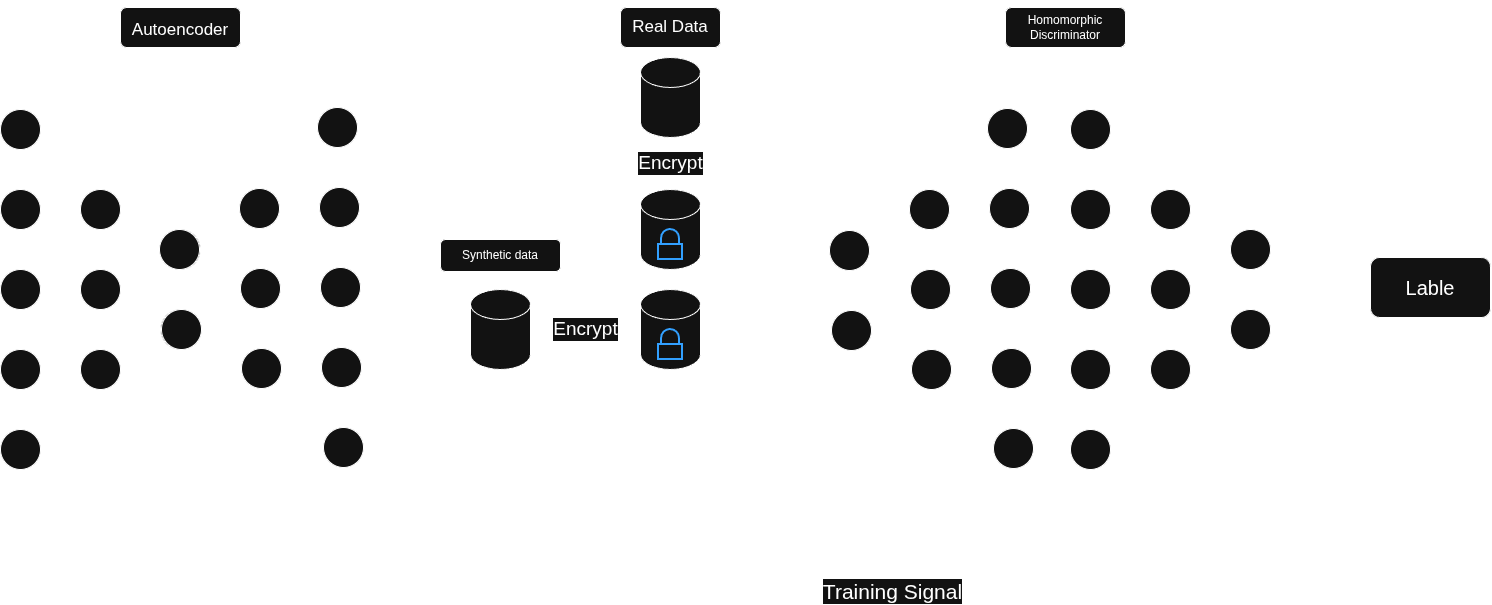
PrivSynth is a privacy-conscious alternative to existing data synthesis services. Instead of handing raw data to a third party to generate a synthetic version of it, the dataset is encrypted first and a homomorphic neural network trains directly on the encrypted data — the provider of the model never sees the underlying values. This matters for applications where data is restricted by strict privacy agreements, such as census microdata or health records.
In the target architecture, an autoencoder learns the shape of the real data and produces synthetic rows. Both the real and synthetic data are then encrypted using CKKS, a homomorphic-encryption scheme that supports approximate arithmetic on encrypted real numbers. A homomorphic discriminator scores the encrypted real and synthetic data directly — without ever decrypting it — and produces a real-vs-synthetic label. That score becomes a training signal sent back to the autoencoder, closing the adversarial loop without exposing any raw value along the way.
The current implementation covers the adversarial training core: a WGAN-GP generator and critic built with TensorFlow/Keras, with preprocessing that scales continuous features (MinMaxScaler) and one-hot encodes categorical ones before inverse-transforming generated samples back into human-readable rows. It’s being tested against Iowa ACS PUMS person-level microdata. The homomorphic-encryption side of the pipeline — encrypting the data and scoring it with the homomorphic discriminator — is still in planning and not yet wired up end-to-end.
Technologies: TensorFlow, Keras, WGAN-GP, homomorphic encryption (CKKS), pandas, scikit-learn