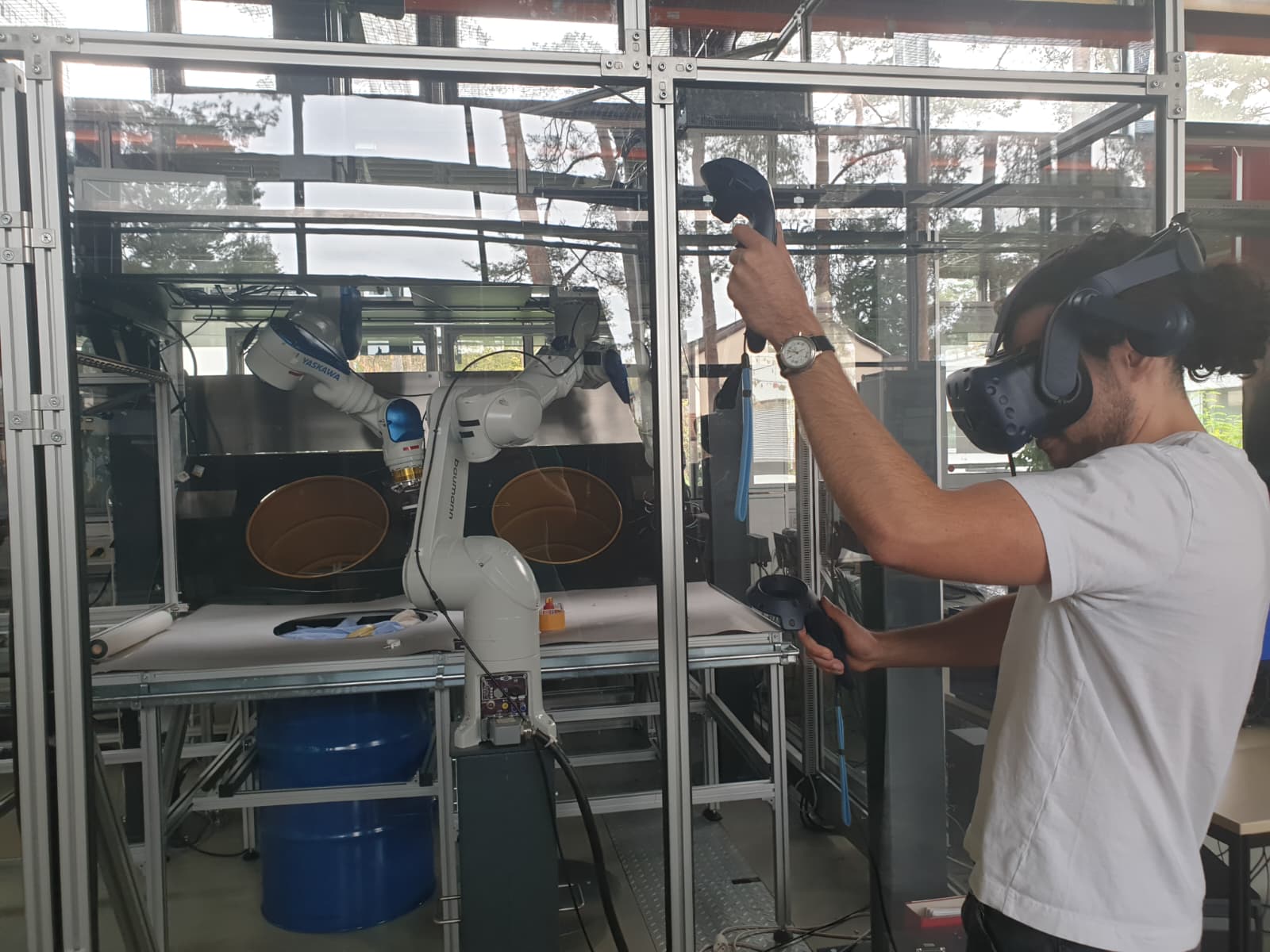
My bachelor thesis at FAU Erlangen-Nürnberg (“Optimizing Robotic Bin-Picking of Radioactive Debris using Supervised and Imitation Learning”) developed a neural network-based part selection system to improve robotic bin-picking for the semi-autonomous handling of radioactive waste.
Training data was generated through VR teleoperation and simulation in Unity: human operators demonstrated grasping motions in a VR rig (VIRERO), and the demonstrations were used for supervised and imitation learning (behavioral cloning, GAIL) alongside RL policies (PPO/SAC) built on Unity ML-Agents. The final system achieved a grasp accuracy of 73% (a 5 percentage-point improvement over the previous system) while adding only 1.2 ms of latency.
The underlying Unity simulation models the robot cell with URDF robot models and ROS integration (ROS#); trained policies were exported as ONNX models, with trainer configurations covering task variants from full bin-picking with the robot in the loop down to isolated move-to-grasp-pose subtasks.
Technologies: PyTorch, Vive VR, ROS, YOLO, Unity (C#), ML-Agents